🧶 Beautiful ✨ Detailed 💝 Adorable

Kawaii Animal Planter Amigurumi Pattern

Kawaii Animal Planter Amigurumi Pattern
4.4★Rating
4-6 HoursTime Needed
3.4KMade This
✂️

Intermediate Level

Ideal for those with basic crocheting experience, featuring slightly more advanced stitches and techniques to expand your skills.

⏱️

Quick Craft

Fits nicely into a free afternoon — 2 to 5 hours of focused, enjoyable crocheting.

🐰

Whimsical Buddy

Playful characters full of personality, designed to spark imagination and become cherished playtime favorites.

About This Kawaii Animal Planter Amigurumi Pattern

Kawaii Animal Planter Amigurumi Pattern crochet pattern - detailed view

These make genuinely wonderful handmade gifts — thoughtful enough to feel special, small enough to sit on any desk or windowsill, and quirky enough that the person receiving one will actually display it.

Why You'll Love This Kawaii Animal Planter Amigurumi Pattern

I'll be honest — I picked this up because the spider planter made me laugh, and I ended up making all four versions back to back. There's something really satisfying about how the pot construction is the same base for every character and then the details are what make each one its own thing. The cow horns being worked right into the dirt round is genuinely clever, and figuring out the no-sew leg attachment for the spider felt like solving a little puzzle. I also love that these are small enough to finish in one sitting if you're focused — there's nothing better than that feeling of holding a finished tiny creature at the end of an afternoon.

Kawaii Animal Planter Amigurumi Pattern step 1 Kawaii Animal Planter Amigurumi Pattern step 2 Kawaii Animal Planter Amigurumi Pattern step 3 Kawaii Animal Planter Amigurumi Pattern step 4

Switch Things Up

I have a real soft spot for crochet projects that don't take themselves too seriously, and this planter pattern is peak 'chaotic cute.' The first time I saw a little crocheted spider with a succulent growing out of it I genuinely laughed out loud, and then immediately started casting on.

What I didn't expect was how clever the construction actually is. The pot is the same base for every single character — same rounds, same shaping — and then all the personality gets layered on top through color changes, accessories, and whatever plant you choose to pop out of the dirt. It's such a smart way to build a pattern that gives you four completely different finished objects from one core structure.

My personal favorite detail is the cow horn round. Instead of making the horns as separate pieces and sewing them on, they're worked right into the dirt round — you're just crocheting along and suddenly you're making a tiny horn and then carrying on like nothing happened. It's one of those moments where you stop and go 'oh that's genuinely clever.'

If you're making the spider, I really recommend doing a trial run of the no-sew leg attachment before you commit to it on your actual pot. Work a few practice rounds on some scrap yarn to get the feel of crocheting through both the leg and the pot fabric at the same time. Once you've got the rhythm it's not hard, but the first time feels a little awkward and you don't want to be figuring it out mid-round 14.

Color-wise, don't feel locked into the versions shown. A pastel lilac pot with a little ghost plant on top? A burnt orange pot with autumn leaves? The pot shape and the plant system both lend themselves really well to seasonal swaps, and the assembly is the same no matter what colors you choose.

Common Mistakes & How to Fix Them

✗ Attaching the spider legs unevenly around the pot is really common — the pattern calls for groups of 4 legs on each side, so count your stitch spacing carefully before committing and pin all 8 in place at once so you can step back and check the symmetry.✗ When working the cow color changes in rounds 12 through 16, it's easy to carry the wrong yarn color too loosely or too tightly across the back, which puckers the fabric — keep your tension consistent and catch the unused yarn every few stitches.✗ The BLO round on the pot (round 6) creates the rim detail that makes the pot look dimensional, but skipping it or working it in both loops flattens the whole shape — double-check you're only catching that back loop before moving on.✗ The dirt section attaches to the back loops left from round 20, but if you've already fastened off and lost track of which loops are which, the dirt won't sit flush — use a stitch marker to flag those loops before you fasten off the pot.✗ For the venus fly trap, the red and green trap pieces need to be placed back-to-back before continuing in green for rounds 3 onward — joining them facing the wrong direction means the red interior won't show when the trap is folded closed.✗ The polar bear ears and the cow ears use the same basic construction but get finished differently — the cow ears get a slip stitch pinch across the top to shape them, and skipping that step leaves them looking flat and shapeless instead of perky.

Kawaii Animal Planter Amigurumi Pattern

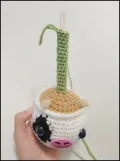
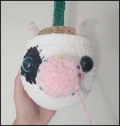
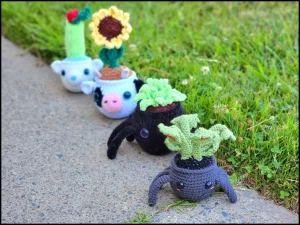
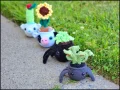
Picture a tiny crocheted pot with big glossy eyes, little ears, and a plant sprouting out the top — that's exactly what you're going to make with this pattern. You get four completely different planters to choose from: a black-and-white cow, a fluffy polar bear, a creepy-cute spider, and a sunflower version that's just pure joy. Each one has its own plant topper, its own face details, and its own little personality. This is the kind of project you start on a Saturday afternoon and can't put down because you keep wanting to see what the finished face looks like.

Intermediate 4-6 Hours

Materials Needed for Kawaii Animal Planter Amigurumi Pattern

— Main Fabric

  • 01
    Worsted weight yarn, approximately 75g in your main pot color — this is the bulk of what you'll use for the pot body itself
  • 02
    About 25g total of accent colors, which vary depending on which planter you're making (black and white for the cow, white for the polar bear, dark grey or black for the spider)
  • 03
    Small amounts of pink worsted weight yarn for the cow's muzzle
  • 04
    Green yarn for the plant toppers — used for the stem, succulent leaves, cactus body, venus fly trap stems, and sunflower leaves
  • 05
    Brown yarn for the dirt section on all planters and for the sunflower center
  • 06
    Yellow yarn for the sunflower petals
  • 07
    Red yarn for the venus fly trap heads and the polar bear cactus berries
  • 08
    A horn-colored yarn (contrasting from dirt) for the cow's two small horns worked into the dirt round

— Tools Required

  • 01
    3.25 mm crochet hook (size D) for standard worsted weight construction
  • 02
    3.75 mm crochet hook (size F) if using bulky weight yarn for the spider version
  • 03
    16 mm safety eyes for the standard worsted weight planters
  • 04
    21 mm safety eyes for the bulky spider version
  • 05
    24 mm safety eyes for the cow planter
  • 06
    20 mm safety eyes for the polar bear planter
  • 07
    18 mm safety nose for the polar bear nose piece
  • 08
    Fiberfill stuffing for the pot body
  • 09
    Tapestry or yarn needle for sewing pieces together and weaving in ends
  • 10
    Scissors
  • 11
    Stitch marker to track the start of each round
  • 12
    Pipe cleaners (optional) for adding poseable shaping to the spider legs
  • 13
    A wooden dowel or similar thin rigid support to insert into the cow stem and keep it upright
  • 14
    Cake dowel (optional) for the venus fly trap stems

Progress Tracker

0% Complete

— 1. Pot (all versions — worked bottom to top) :

Info :

Work in a continuous spiral throughout — do not join rounds unless the pattern specifically says to. Keep a stitch marker at the start of every round. All stitches go through both loops unless a round is labeled BLO or FLO. For the spider version, make the legs first if you want to use the no-sew attachment method (see Spider Legs section). Cow color change rounds are listed separately at the end of this section.

Round 1 :

Start with your pot color. Work 8 sc into a mr. (8)

Round 2 :

inc in every st around. (16)

Round 3 :

(sc, inc) x 8. (24)

Round 4 :

(3 sc, inc) x 6. (30)

Round 5 :

(4 sc, inc) x 6. (36)

Round 6 :

BLO: sc in every st around. (36)

Round 7 :

sc in every st around. (36)

Round 8 :

(5 sc, inc) x 6. (42)

Round 9 :

sc in every st around. (42)

Round 10 :

(6 sc, inc) x 6. (48)

Info :

Spider no-sew leg attachment: If you're attaching legs as you work, use this modified version of Round 14 instead of a plain sc round — 2 sc, then (work 3 sc simultaneously through the leg and the pot, sc) x 4, then 11 sc, then (work 3 sc simultaneously through the leg and pot, sc) x 4, then 3 sc. This locks 4 legs on each side without sewing.

Round 11 :

sc in every st around. (48)

Round 12 :

sc in every st around. (48) — For cow color changes, see Cow Pot section below.

Round 13 :

sc in every st around. (48) — For cow color changes, see Cow Pot section below.

Round 14 :

sc in every st around. (48) — For cow color changes, see Cow Pot section below. For spider (no-sew): use the modified leg-attachment round described in the Info step above.

Info :

Eye placement: For the spider, place safety eyes between rounds 14 and 15, leaving 8 stitches between them. For the cow and polar bear, place eyes between rounds 14 and 15, leaving 10 stitches between them.

Round 15 :

sc in every st around. (48) — For cow color changes, see Cow Pot section below.

Round 16 :

sc in every st around. (48) — For cow color changes, see Cow Pot section below.

Round 17 :

(6 sc, dec) x 6. (42)

Round 18 :

(5 sc, dec) x 6. (36)

Round 19 :

sc in every st around. (36)

Round 20 :

FLO: ch 1, hdc in every st around. (36)

Info :

F/O and leave a tail for finishing. The back loops remaining from round 20 will be used to attach the dirt section.

— 2. Cow Pot — Color Change Rounds :

Info :

Work rounds 1–11 of the pot in white. Begin color changes at round 12. Switch colors mid-round as listed. All other rounds follow the standard pot instructions.

Round 12 :

White: 20 sc, Black: 3 sc, White: 25 sc. (48)

Round 13 :

White: 19 sc, Black: 7 sc, White: 22 sc. (48)

Round 14 :

White: 19 sc, Black: 7 sc, White: 22 sc. (48)

Round 15 :

White: 19 sc, Black: 6 sc, White: 23 sc. (48)

Round 16 :

White: 20 sc, Black: 5 sc, White: 23 sc. (48)

Round 17 :

White: (6 sc, dec) x 2, then 5 sc. Black: sc, dec. White: (6 sc, dec) x 3. (42)

— 3. Spider Legs (make 8) :

Round 1 :

Work 7 sc into a mr. (7)

Round 2-12 :

sc in every st around for 11 rounds. (7)

Info :

Do not stuff the legs. If you'd like them to hold a pose, slip a pipe cleaner inside before closing. Fold each leg in half lengthwise and sc across the opening to close it flat. F/O and leave a long tail for sewing — unless you used the no-sew pot method, in which case the legs are already attached.

— 4. Polar Bear Ears (make 2) :

Info :

Work in white yarn throughout.

Round 1 :

Work 6 sc into a mr. (6)

Round 2 :

inc in every st around. (12)

Round 3 :

(sc, inc) x 6. (18)

Round 4 :

sc in every st around. (18)

Round 5 :

(sc, dec) x 6. (12)

Info :

Do not stuff. Fold the ear in half and sc across the open edge to close it. F/O and leave a long tail for sewing onto the pot.

— 5. Dirt on Pot (all versions) :

Info :

Join your dirt-colored yarn to the back loops left over from round 20 of the pot. Work into those back loops only.

Round 1 :

(4 sc, dec) x 6. (30) — For the cow version, see the special cow horn round below instead.

Info :

Cow horn round 1 (replaces standard round 1): Dirt color: 4 sc, dec, 3 sc. Horn color: ch 4, then inc3 in the 2nd ch from hook, hdc in next ch, dc in last ch (first horn made). Dirt color: sc, dec, 4 sc, dec, 2 sc. Work a second horn the same way. Dirt color: 2 sc, dec, (4 sc, dec) x 2. (30)

Round 2 :

(3 sc, dec) x 6. (24)

Round 3 :

(2 sc, dec) x 6. (18)

Round 4 :

(sc, dec) x 6. (12)

Round 5 :

dec x 6. (6)

Info :

If you're making the cow version, do NOT fasten off here — continue directly with the green stem. For all other versions, F/O and close the remaining hole by sewing it shut.

— 6. Cow/Sunflower Stem (worked after dirt, in green) :

Info :

Change to green yarn, continuing from where the dirt section ended (do not fasten off).

Round 1-18 :

sc in every st around for 18 rounds. (6)

Info :

Insert a wooden dowel or similar support into the stem to keep it upright. F/O and sew the tip of the stem closed.

— 7. Polar Bear Nose :

Info :

Work in white yarn.

Round 1 :

Work 6 sc into a mr. (6)

Round 2 :

inc in every st around. (12)

Round 3 :

(sc, inc) x 6. (18)

Round 4 :

sc in every st around. (18)

Round 5 :

sc in every st around. (18)

Info :

Place the 18 mm safety nose between rounds 1 and 2 before fastening off. F/O and leave a long tail for sewing onto the pot.

— 8. Cow Ears (make 2 — one black, one white) :

Round 1 :

Work 6 sc into a mr. (6)

Round 2 :

inc in every st around. (12)

Round 3 :

(sc, inc) x 6. (18)

Info :

Skip 4 sts, then sl st in the next st. Sl st across the top of the ear to create a pinched, folded shape. F/O and leave a long tail for sewing.

— 9. Cow Nose :

Info :

Work in pink yarn. Begin with a foundation chain.

Foundation :

ch 4.

Round 1 :

inc in the 2nd ch from hook, sc in next ch, inc3 in last ch. Turn and work back along the other side of the chain: 3 sc. (9)

Round 2 :

inc x 2, 2 sc, inc x 3, sc, inc. (15)

Round 3 :

(sc, inc) x 2, 2 sc, (sc, inc) x 3, 2 sc, inc. (21)

Round 4 :

sc in every st around. (21)

Round 5 :

sc in every st around. (21)

Info :

F/O and leave a long tail for sewing. Embroider 2 nostrils after attaching to the pot.

— 10. Sunflower :

Info :

Begin with brown yarn.

Round 1 :

Work 5 sc into a mr. (5)

Round 2 :

inc in every st around. (10)

Round 3 :

(sc, inc) x 5. (15)

Round 4 :

(2 sc, inc) x 5. (20)

Round 5 :

(3 sc, inc) x 5. (25)

Colour Change :

Switch to yellow yarn.

Round 6 :

Work petal repeat all the way around: (ch 5, sc in 2nd ch from hook, hdc in next ch, dc in next ch, tr in last ch of the ch-5, sl st in next 2 sts of the flower center) — repeat this petal sequence around the entire round. F/O and leave a long tail for sewing.

— 11. Sunflower Leaf #1 :

Info :

Work in green yarn.

Foundation :

ch 7.

Row 1 :

Working along the chain: dc + tr in the 3rd ch from hook, 2 tr in next ch, 2 dc in next ch, hdc in next ch, sc in last ch. F/O and leave a long tail for sewing.

— 12. Sunflower Leaf #2 :

Info :

Work in green yarn.

Foundation :

ch 7.

Row 1 :

sc in 3rd ch from hook, hdc in next ch, 2 dc in next ch, 2 tr in next ch, tr + dc in last ch. F/O and leave a long tail for sewing.

— 13. Spider Succulent :

Info :

Join green yarn with a sl st between rounds 2 and 3 of the completed pot.

Round 1 :

Ch 7. Then: sl st in 2nd ch from hook, sc in next ch, hdc in next ch, dc in next 2 chs, tr in next ch, sl st in next 2 sts of the pot. Repeat this leaf sequence all the way around until you reach the center of the pot opening.

— 14. Venus Fly Trap — Stems (make 4) :

Round 1 :

Work 6 sc into a mr. (6)

Round 2-16 :

sc in every st around for 15 rounds. (6)

Info :

Do not stuff the stems. A thin cake dowel can be inserted for structure. F/O and leave a long tail for sewing.

— 15. Venus Fly Trap — Trap Heads (make 4 red and 4 green) :

Info :

Begin each trap by making a red piece and a green piece separately through round 2. Then join them together and continue in green.

Round 1 :

Work 6 sc into a mr. (6) — make this for both the red and green pieces.

Round 2 :

inc in every st around. (12) — make this for both pieces. Do NOT fasten off the green piece.

Info :

Place the red and green pieces back-to-back (wrong sides together). Continue working with the green yarn through both pieces from here.

Round 3 :

Working through both layers: (sc, inc) x 6. (18)

Round 4 :

(2 sc, inc) x 6. (24)

Round 5 :

(ch 3, sl st in same st, sl st in next 2 sts) — repeat around the entire edge. F/O and leave a long tail for sewing.

— 16. Venus Fly Trap — Leaves (make 3) :

Foundation :

ch 15.

Row 1 :

sc in 2nd ch from hook, 2 hdc, 2 dc, 4 tr, 2 dc, 2 hdc, inc in the last ch. Then working back along the other side of the foundation chain: sc, 2 hdc, 2 dc, 4 tr, 2 dc, 2 hdc, sc. F/O and leave a long tail for sewing.

— 17. Polar Bear Cactus :

Info :

Work in green yarn. This piece is crocheted flat (rows) and then seamed into a tube.

Foundation :

ch 20.

Row 1 :

sc in 2nd ch from hook and across. (19)

Row 2-16 :

BLO: ch 1, turn, sc in every st across for 15 rows. (19)

Info :

F/O and leave a very long tail for sewing. Seam the cactus into a tube, stuff it, then sew the top closed. Attach to the top of the pot.

— 18. Polar Bear Cactus — Holly Leaves (make 2) :

Foundation :

ch 10 in green yarn.

Row 1 :

sc in 2nd ch from hook, sc, hdc, dc, dc-inc, dc, hdc, sc, inc3 in the last ch. Working back along the other side: sc, hdc, dc, dc-inc, dc, hdc, sc, sl st in last st.

Row 2 :

sc, (ch 3, sl st in same st) — spike made, 4 sc, spike, 4 sc, spike, 2 sc, spike, 4 sc, spike, 3 sc, sl st to first st. F/O and leave a long tail for sewing.

— 19. Polar Bear Cactus — Berries (make 2) :

Info :

Work in red yarn.

Round 1 :

Work 6 sc into a mr. (6)

Round 2 :

sc in every st around. (6)

Round 3 :

dec x 3. (3)

Info :

Pull the yarn through the remaining stitches to close the berry. F/O and leave a long tail for sewing.

Assembly Instructions

  • Before assembling any version, make sure all safety eyes are secured — they go between rounds 14 and 15, spaced 10 stitches apart for the cow and polar bear, and 8 stitches apart for the spider. Do this before stuffing the pot.
  • For the cow: pin the pink oval nose piece centered on the front of the pot between the eyes, then sew it down securely. Once attached, embroider two small nostrils on the nose. Pin one black ear and one white ear symmetrically onto the upper sides of the pot and sew them in place.
  • For the polar bear: pin the white nose piece onto the front of the pot and sew it down. Place the 18 mm safety nose through the nose piece between rounds 1 and 2 before attaching. Pin the two white ears onto the upper sides and sew them on.
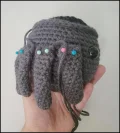
  • For the spider: if you did not use the no-sew leg method, pin all 8 legs around the sides of the pot (4 on each side), spacing them evenly. Sew each leg firmly to the pot. Embroider a face expression if desired.
  • Attach the dirt section to the pot by working into the back loops remaining from round 20 — no sewing required, this is worked directly. For the cow, the horns are built into dirt round 1. Once the dirt is complete, for all non-cow versions sew the top hole closed.
  • For the cow and sunflower: attach the stem leaves to the bottom portion of the green stem before sewing the stem to the top of the pot. Then attach the sunflower head to the very top of the stem.
  • For the venus fly trap: sew the four stems onto the top of the pot opening. Fold each trap head in half and tack the back layer closed to give a clamshell look, then sew each trap to the tip of a stem. Sew the three large leaves around the base at the top of the pot. For the polar bear cactus: seam and stuff the cactus body, sew it to the pot top, then attach the holly leaves and berries to the cactus.

Important Notes

  • 💡Work the entire pot in a continuous spiral — closing rounds with a slip stitch will create a visible seam that breaks the smooth round shape of the pot body, so keep moving and use your stitch marker religiously.
  • 💡Round 6 is a BLO round that forms the visual ridge separating the flat base from the pot walls — if you accidentally work it through both loops, the whole pot loses its dimensional shape, so slow down here and check your hook placement.
  • 💡The back loops left over from the FLO round 20 are your attachment point for the dirt section — do not cut these or lose track of them before joining the dirt yarn, because there's no easy way to recover them once the edge is disturbed.
  • 💡For the cow color changes, always twist the old and new yarn colors around each other at every switch to avoid holes or loose floats on the inside of the pot — it makes the finished piece much cleaner.
  • 💡Spider legs should not be stuffed — they need to fold flat and lie naturally against the pot. If you want them to curve or pose, a pipe cleaner inserted before folding gives you full control over the positioning.
  • 💡When making the venus fly trap heads, the back-to-back placement of the red and green pieces before continuing in round 3 is the step that gives the trap its two-toned look — rushing through the join or getting the orientation wrong means the red side won't be visible when the trap is folded.

However you're drawn to this pattern — maybe you're a plant lover who thought 'what if my succulent had a face', or maybe you just saw the spider version and immediately needed it in your life — you're going to have so much fun making these little guys. 🧶 They're genuinely charming on a desk, a shelf, a windowsill, or wrapped up as a gift. Each planter has its own personality, and once you make one you'll probably want the whole set. Happy hooking! ✨🌵
You ask,

we answer.

FAQs

Can I make all four planters with one purchase of yarn?

Easily, yes — you need roughly 75g of each main pot color and about 25g of accent shades per planter. If you buy a single skein of worsted weight in each main color (white, black/dark grey, and whatever you choose for the sunflower pot), plus small amounts of green, brown, pink, and yellow, you'll have more than enough for all four versions with yarn left over.

How do I keep the cow stem from flopping over?

The pattern recommends inserting a wooden dowel or something similar into the green stem before closing the tip. A cake pop stick, a bamboo skewer with the sharp end trimmed, or even a stiff pipe cleaner all work well. Without any support the stem will lean — it's too narrow to hold itself upright at 6 stitches wide.

The spider has 8 legs — is there a way to attach them without sewing each one individually?

Yes — that's exactly what the no-sew method in the pattern is for. You make the legs first, then during round 14 of the pot you work 3 stitches simultaneously through the leg and the pot fabric to lock each leg in place as you crochet. It takes a bit more focus but saves a lot of finishing time and gives a very secure hold.

I'm struggling with the BLO round on the pot — why does it matter so much?

That BLO round (round 6) is what creates the little shelf or ridge at the base of the pot walls — it's the detail that makes the finished pot look like a real plant pot rather than a plain ball. The front loops left behind from that round also form a decorative edge on the bottom rim. Working it correctly through the back loops only is what makes that ridge pop.

Can I use a different yarn weight to make a bigger planter?

The pattern actually includes a bulky weight option — just switch to an F hook (3.75 mm) and bulky yarn. The spider version specifically calls for 21 mm safety eyes when worked in bulky weight, so adjust your eye size accordingly. Going bulky will make the finished planter noticeably larger and chunkier, which looks great for the spider version especially.

Do the polar bear ears get stuffed before sewing on?

No — the ears are folded flat and slip-stitched closed before attaching, so they're completely unstuffed. Same goes for the cow ears. The fold is what gives them their shape. Stuffing them would make them round and puffy rather than the flat, perky ear shape you see in the finished photos.