🧶 Beautiful ✨ Detailed 💝 Adorable

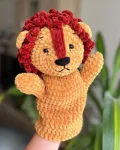
Crochet Lion Hand Puppet Amigurumi Pattern

Crochet Lion Hand Puppet Amigurumi Pattern
4.5★Rating
3-5 HoursTime Needed
2.9KMade This
✂️

Intermediate Level

Ideal for those with basic crocheting experience, featuring slightly more advanced stitches and techniques to expand your skills.

⏱️

Quick Craft

Fits nicely into a free afternoon — 2 to 5 hours of focused, enjoyable crocheting.

🐰

Whimsical Buddy

Playful characters full of personality, designed to spark imagination and become cherished playtime favorites.

About This Crochet Lion Hand Puppet Amigurumi Pattern

Crochet Lion Hand Puppet Amigurumi Pattern crochet pattern - detailed view

This puppet makes a brilliant handmade gift for a child who loves imaginative play — thoughtful enough to feel special, and finished enough to look like something from a boutique.

Why You'll Love This Crochet Lion Hand Puppet Amigurumi Pattern

I fell hard for this one the moment the mane rounds came together. There's something so satisfying about attaching those looped chain rows and watching a flat crocheted ball suddenly look like an actual lion. The arms-into-body technique is one of those things that feels a little scary the first time and then becomes your new favourite trick. I also love that this puppet skips the stuffing in the arms — it keeps things nice and floppy, which is exactly what you want for puppet play. Honestly, I kept picking it up off my desk just to make the lion 'talk.'

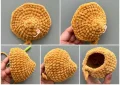
Crochet Lion Hand Puppet Amigurumi Pattern step 1 Crochet Lion Hand Puppet Amigurumi Pattern step 2 Crochet Lion Hand Puppet Amigurumi Pattern step 3 Crochet Lion Hand Puppet Amigurumi Pattern step 4

Switch Things Up

I have a soft spot for patterns that do double duty — something that's fun to make AND genuinely useful once it's done. This lion puppet is exactly that kind of project.

I picked it up on a quiet weekend afternoon, mostly because I had a skein of plush yarn sitting in my stash and nothing good planned. By the time I'd finished the head and laid it on my table with those little sunken eyes staring up at me, I was completely smitten. There's a specific kind of magic that happens with safety eyes in plush yarn — something about the contrast makes a face look almost cartoon-animated before you've even added a single embroidered line.

The mane is where this one really surprised me. I was a little skeptical about the chain-loop technique — it sounded fiddly — but it actually works up fast and the result is so much fluffier than I expected. The two rows at different chain lengths (8 for the first pass, 9 for the second) create this layered effect that genuinely looks like a real mane rather than a flat ruffle. Little tip: go slowly on the second mane row and really let those loops fan forward. They'll look wild while you're working them and then settle into place beautifully.

If you want to try a colour variation, a golden yellow mane instead of brown gives a younger, sunnier lion vibe — or try a deep terracotta for something more dramatic. The plush yarn takes colour so well that even simple swaps completely change the personality of the finished puppet.

Once your lion is done, slip your hand in and give him a little voice. You'll understand immediately why puppets have been making kids laugh for centuries.

Common Mistakes & How to Fix Them

✗ When placing the safety eyes between rounds 5 and 6, it's easy to set them too close together — the pattern specifies 10 sc between them, so count carefully before snapping them in because once the backing is secured, you can't move them.✗ The body starts with a chain circle rather than a magic ring, and many crocheters accidentally slip stitch into the wrong loop when forming that starting circle — make sure you sl st into the very first chain you made, not the second one.✗ During Round 5 of the body, when you crochet the arms in simultaneously, it's tempting to skip the sc2tog joins at each sleeve edge — but those decrease joins are what close the gap between arm and body fabric, so don't skip them or you'll have visible holes.✗ The mane is attached in two separate rounds starting at different positions on the head — the first row uses 8-chain loops and the second uses 9-chain loops. Swapping these or starting from the wrong stitch position will make the mane look lopsided rather than framing the face evenly.✗ When embroidering the nose detail with brown plush yarn, the 4 radiating lines from the magic ring centre need to fan outward toward the mane — if you pull too tight, the face fabric will pucker and distort the shape of the snout area.✗ The ear placement calls for the distance between ears to be 11 stitches apart, positioned between rounds 10 and 11 from the magic ring. Placing them even one round lower makes the ears look like they're sliding off the sides of the head rather than sitting naturally on top.

Crochet Lion Hand Puppet Amigurumi Pattern

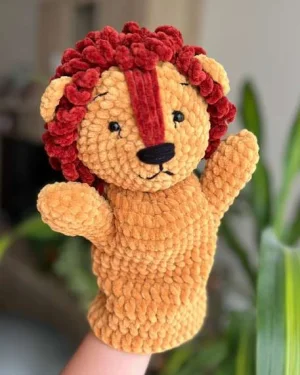
This little lion is ready to put on a show — and honestly, making him is half the fun. You'll work through a satisfying mix of plush yarn and cotton details that come together into something genuinely special. The chunky plush body feels great in your hands as you go, and watching that fluffy mane take shape around his face is one of those crafting moments you'll want to repeat. Whether you're making this for a child's toy box or a nursery shelf, it's the kind of project that feels like play from start to finish. Your hands will love the texture, your heart will love the result.

Intermediate 3-5 Hours

Materials Needed for Crochet Lion Hand Puppet Amigurumi Pattern

— Main Fabric

  • 01
    Super bulky plush yarn (such as Himalaya Dolphin Baby, approximately 120m per 100g skein) in dark yellow — 1 skein used for the head, body, arms, and ears
  • 02
    Super bulky plush yarn in brown (same yarn weight, colour No. 80370) for crocheting the lion's fluffy mane
  • 03
    Sport weight cotton yarn (such as Yarn Art Jeans, approximately 160m per 50g ball) in black for embroidering the nose, mouth, eyes, and eyebrows

— Tools Required

  • 01
    4.5 mm crochet hook for all main pieces
  • 02
    Large blunt-tip tapestry needle for sewing pieces together and embroidery
  • 03
    Stitch markers to track round beginnings
  • 04
    Two 7 mm plastic safety eyes
  • 05
    Polyester fiber filling for stuffing the head
  • 06
    Scissors

Progress Tracker

0% Complete

— 1. Head :

Info :

Work with dark yellow plush yarn and a 4.5 mm hook throughout the head section.

Round 1 :

Start with a MR and work 6 sc into it. (6)

Round 2 :

Work 1 inc in each stitch around. (12)

Round 3 :

Work (1 sc, 1 inc) 6 times around. (18)

Round 4 :

Work (1 sc, 1 inc) 6 times, then 6 sc. (24)

Round 5 :

Work (2 sc, 1 inc) 6 times, then 6 sc. (30)

Round 6 :

Work (3 sc, 1 inc) 6 times, then 6 sc. (36)

Round 7 :

Work (4 sc, 1 inc) 6 times, then 6 sc. (42)

Round 8 :

42 sc around. (42)

Round 9 :

42 sc around. (42)

Round 10 :

42 sc around. (42)

Round 11 :

42 sc around. (42)

Round 12 :

42 sc around. (42)

Round 13 :

Work (5 sc, 1 dec) 6 times around. (36)

Round 14 :

Work (4 sc, 1 dec) 6 times around. (30)

Round 15 :

Work (3 sc, 1 dec) 6 times around. (24)

Info :

Insert the 7 mm plastic safety eyes now, positioning them between rounds 5 and 6 counting from the magic ring (on the nose side). Leave 10 sc between the two eyes. Then stuff the head firmly with fiber filling before continuing.

Round 16 :

Work (2 sc, 1 dec) 6 times around. (18)

Round 17 :

Work (1 sc, 1 dec) 6 times around. (12)

Round 18 :

Work 1 dec in each stitch around. (6)

Info :

Thread the yarn tail through the 6 remaining front loops and pull firmly to close the opening. Fasten off and secure.

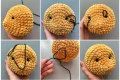
— 2. Eye Indenting (Embroidery) :

Info :

Switch to black cotton yarn and a large needle for this step. Thread the needle and push it through the back of the head, bringing the tip out just above the right eye. Leave a tail at the back.

Info :

Pass the needle from underneath the left eye and bring it out beneath the right eye, keeping the yarn running along the inside of the left eye. Then pass the needle down from above the right eye so the thread sits inside that eye too, and pull the needle back out through the same point at the rear of the head.

Info :

Draw both thread ends firmly so the eyes sink inward. Tie the ends together in a secure knot at the back and bury the tails inside the head.

— 3. Ears (Make 2) :

Info :

Work with dark yellow plush yarn and a 4.5 mm hook. Make two identical ears.

Round 1 :

Work 6 sc into a MR. (6)

Round 2 :

Work 1 inc in each stitch around. (12)

Round 3 :

Work (1 sc, 1 inc) 3 times, then sl st. (9 sc + sl st)

Info :

Leave a long yarn tail for sewing and cut the yarn. Repeat for the second ear.

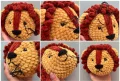
— 4. Mane :

Info :

Work with brown plush yarn and a 4.5 mm hook. Attach the yarn at the stitch between rounds 9 and 10 from the nose side, positioned 5 stitches below the left ear.

Round 1 :

Working across the upper section of the lion's face: *work 8 ch, then sl st into the next stitch*. Repeat from * to * all the way across the upper face. Fasten off and cut the yarn.

Info :

Reattach the brown yarn at the stitch between rounds 11 and 12 from the nose side, 5 stitches below the right ear.

Round 2 :

Working across the upper section of the lion's face: *work 9 ch, then sl st into the next stitch*. Repeat from * to * all the way across the upper face. Fasten off and cut the yarn.

— 5. Nose & Face Embroidery :

Info :

Using brown plush yarn threaded onto a large needle, embroider 4 straight lines radiating outward from the center of the magic ring toward the mane. Fasten off and secure the yarn.

Info :

Switch to black cotton yarn on a large needle. Embroider the black nose shape as shown in the pattern photos, then add the mouth below it.

Info :

Using a thin cotton yarn on the large needle, embroider the eye outlines, eyebrow lines, and mouth detail lines to complete the lion's face.

— 6. Arms (Make 2) :

Info :

Work with dark yellow plush yarn and a 4.5 mm hook. Make two arms. Do not stuff them.

Round 1 :

Work 6 sc into a MR. (6)

Round 2 :

Work 1 inc in each stitch around. (12)

Round 3 :

Work (2 sc, 1 inc) 4 times around. (16)

Round 4 :

16 sc around. (16)

Round 5 :

16 sc around. (16)

Round 6 :

Work (2 sc, 1 dec) 4 times around. (12)

Round 7 :

12 sc around. (12)

Round 8 :

12 sc around. (12)

Round 9 :

12 sc around. (12)

Info :

Work 1 sl st, then cut and fasten off the yarn. Do not stuff. Make a second arm the same way.

— 7. Body :

Info :

Work with dark yellow plush yarn and a 4.5 mm hook. Leave a long starting tail for sewing. Begin without a sl st — chain 24, then sl st into the very first chain to form a ring.

Round 1 :

Work 24 sc around the ring. (24)

Round 2 :

Work (3 sc, 1 inc) 6 times around. (30)

Round 3 :

Work (4 sc, 1 inc) 6 times around. (36)

Round 4 :

Work (5 sc, 1 inc) 6 times around. (42)

Round 5 :

Work this round joining the arms into the body: crochet 7 sc working through both the body and the first arm together, then 13 sc on the body only, then 7 sc working through both the body and the second arm together, then 15 sc on the body only. (42) Work sc2tog at both sides of each sleeve join to close any gaps.

Round 6 :

sc2tog, then 4 sc on the first arm only, sc2tog, 12 sc on the body only, sc2tog, 4 sc on the second arm only, sc2tog, 14 sc on the body only. (38)

Round 7 :

dec, 2 sc, dec, 12 sc, dec, 2 sc, dec, 14 sc. (34)

Round 8 :

34 sc around, then ch 1. (34)

Round 9 :

34 dc around. (34)

Round 10 :

34 dc around. (34)

Round 11 :

34 dc around. (34)

Round 12 :

34 dc around. (34)

Round 13 :

34 dc around. (34)

Round 14 :

34 dc around. (34)

Info :

Work 1 sc, then 1 sl st. Cut the yarn and fasten off securely.

Assembly Instructions

  • Sew the two completed ears onto the head, positioning them between rounds 10 and 11 from the magic ring (nose side), with exactly 11 stitches of space between them.
  • Complete both rounds of the mane in brown yarn before attaching anything else to the head — the mane needs to be fully worked first so the ears sit correctly on top of it.
  • Embroider the full face detail (brown nose lines, black nose and mouth, eye and eyebrow outlines) on the finished head before joining head to body.
  • Attach the arms into the body during Round 5 of the body construction — this is worked live while crocheting, not sewn on afterward. Place the first arm 7 sc across starting from the beginning of the round, and the second arm beginning 13 sc after the first arm join.
  • Work sc2tog at both edges of each arm join immediately after Round 5 to pull the sleeve openings closed and prevent gaps in the fabric.
  • Once the body is complete, sew it firmly onto the bottom of the finished head, positioning the head so the lion's face points forward and the body hangs below with arms at the sides.

Important Notes

  • 💡Insert the safety eyes before completing Round 16 — once you've decreased past that point the opening is too small to get your hand in comfortably for positioning.
  • 💡The body is started from a chain ring rather than a magic ring, which is less common — leave a generous tail at the start because you'll use it later to help sew the body to the head.
  • 💡Don't stuff the arms at all. Keeping them flat and floppy is intentional and makes the puppet much easier to use and more fun for kids to play with.
  • 💡The mane is worked in two separate rounds at different chain lengths — 8-chain loops for the first pass and 9-chain loops for the second. Using the same length for both will flatten the mane and it won't have that full, layered look.
  • 💡When working the plush yarn, the bobbled texture can make it hard to see your stitches clearly. Count at the end of every increase and decrease round rather than every few rounds, or you'll struggle to catch errors.
  • 💡The face embroidery is done in layers — brown plush for the nose lines, then black cotton for the nose and mouth shape, then thin cotton for the eye and eyebrow detail. Do them in that order so the thinner yarn sits on top where it's most visible.

There's something genuinely joyful about finishing a hand puppet — the moment you slip your hand inside and suddenly this little lion comes to life is one of those crafting payoffs that never gets old. 🧶 He's got so much personality packed into that fluffy mane and those sunken eyes, and the tactile pleasure of working with plush yarn makes the whole process feel luxurious from first stitch to last. Whether he ends up as a gift, a prop for storytime, or just the most charming thing sitting on your shelf — he's worth every round. Go make your lion roar! ✨
You ask,

we answer.

FAQs

Can I use regular worsted weight yarn instead of the plush yarn for this pattern?

You can, but the finished puppet will look quite different — the bumpy, bobbled texture that gives this lion so much character comes specifically from the super bulky plush yarn. With worsted weight you'll get a much smaller puppet (probably around 18–20 cm instead of 28 cm) and a smooth fabric that won't have that fluffy lion look. If you do substitute, try a 3.5 mm hook instead of 4.5 mm to keep the fabric tight enough that stuffing doesn't show through.

How do I keep the chain loops in the mane from tangling together?

The mane loops naturally want to cluster and overlap — that's actually part of the look. To keep them somewhat separated while you work, use a stitch marker to hold your place in the rounds and work slowly. Once both mane rounds are complete, you can gently fluff the loops outward with your fingers or a soft brush to separate them into that full, wild-mane shape.

My arms look too stiff and they're not sitting naturally — what went wrong?

The most common cause is accidentally stuffing the arms a little, or pulling the yarn too tight during the decrease round. The arms are meant to be completely unstuffed and slightly floppy — that's what makes them work well as a puppet. If yours feel stiff, check that you haven't overstuffed the body where the arms join at Round 5, as padding that area can also push the arms outward unnaturally.

Is this puppet safe for young toddlers to play with?

The 7 mm safety eyes have locking backings which are secure for most children's toys, but any toy with small plastic parts carries a risk for children under 3 who mouth their toys. If you're making this for a very young child, consider embroidering the eyes in black cotton instead of using plastic safety eyes. All other materials in this pattern — plush yarn, cotton yarn, fiber filling — are soft and safe.

The stitch count on Round 4 of the body shows 'ins' instead of 'inc' — is that a typo?

Yes, that appears to be a typo in the original pattern. Round 4 of the body should read (5 sc, inc) * 6 to give you 42 stitches, which is consistent with the stitch count in parentheses and matches the increase pattern used in rounds 2 and 3. Work it as a standard inc (2 sc in one stitch) and your count will be correct.

How do I attach the head to the body so it doesn't wobble?

Use the long starting tail you left at the beginning of the body chain, plus an additional length of the dark yellow plush yarn if needed. Sew around the full circumference of the neck opening at least twice, catching stitches from both the body edge and the lower rounds of the head. Work in a circular path and pull each stitch firmly — the plush yarn's texture helps grip and holds the join securely without any extra support needed.