🧶 Beautiful ✨ Detailed 💝 Adorable

Quirky Cartoon Snail Amigurumi Pattern

Quirky Cartoon Snail Amigurumi Pattern
4.1★Rating
3-5 HoursTime Needed
3.2KMade This
✂️

Intermediate Level

Ideal for those with basic crocheting experience, featuring slightly more advanced stitches and techniques to expand your skills.

⏱️

Quick Craft

Fits nicely into a free afternoon — 2 to 5 hours of focused, enjoyable crocheting.

🐰

Whimsical Buddy

Playful characters full of personality, designed to spark imagination and become cherished playtime favorites.

About This Quirky Cartoon Snail Amigurumi Pattern

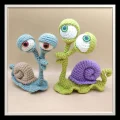
Quirky Cartoon Snail Amigurumi Pattern crochet pattern - detailed view

This snail is a fantastic way to practice wiring amigurumi. It results in a sturdy, poseable toy that looks amazing on a bookshelf or as a unique handmade gift for a nature lover.

Why You'll Love This Quirky Cartoon Snail Amigurumi Pattern

I absolutely adore how these little guys look like they've just crawled out of a cartoon. The poseable eyes are definitely my favorite part—you can make your snail look surprised, curious, or just plain goofy depending on how you bend them. It's such a rewarding project that feels more like sculpting with yarn than just following a standard stitch count.

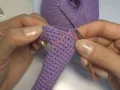
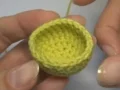
Quirky Cartoon Snail Amigurumi Pattern step 1 Quirky Cartoon Snail Amigurumi Pattern step 2 Quirky Cartoon Snail Amigurumi Pattern step 3 Quirky Cartoon Snail Amigurumi Pattern step 4

Switch Things Up

I have always had a soft spot for crochet projects that feel like they have a soul, and this snail is the perfect example. When I first saw those big, slightly wonky eyes, I knew I had to share this pattern with you all. It’s not your everyday amigurumi; the addition of a wire frame really changes the game, allowing you to pose the eye stalks in ways that convey so much emotion.

One thing I really enjoyed while making my own was the shell construction. It’s worked in a long, tapered tube that you then coil and sew together. It’s such a clever way to get that authentic snail-shell look without overly complex shaping. If you’re feeling adventurous, try using a variegated yarn for the shell to give it some natural-looking color transitions.

Working with wire can be a little fiddly at first, especially when you’re crocheting the body around it, but don’t let that intimidate you. Just take your time and keep your stitches tight to ensure the wire stays hidden. By the time you’re adding the mantle and finishing the base, you’ll see this little guy transform into a sturdy, standing character that’s ready to brighten up any space. I can't wait to see the colors you choose for your snails!

Common Mistakes & How to Fix Them

✗ If you tighten the magic circle on the first round of the lower eyelid too much, you won't be able to fit the wire frame through the tube later.✗ Forgetting to wrap the wire ends with textile tape or a band-aid can lead to sharp edges poking through your stitches over time.✗ Over-stuffing the shell tube makes it very difficult to coil tightly; it’s best to keep the fiberfill light so the shell remains flexible for shaping.✗ When joining the jaws, ensure the wire loop is centered, or your snail's head and eye stalks will sit lopsided on the body.

Quirky Cartoon Snail Amigurumi Pattern

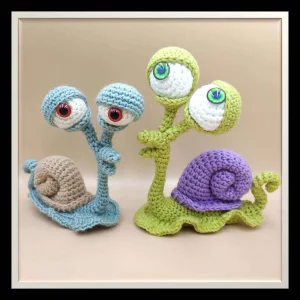
Get ready to create a garden friend with a massive personality! This quirky snail isn't your average slow-mover; with his wide, expressive eyes and poseable stalks, he looks like he just crawled right out of a classic animated film. You will love the process of building the internal wire frame, which gives this little guy so much character and life. It is a fantastic project for anyone looking to move beyond basic shapes and explore sculptural amigurumi techniques.

Intermediate 3-5 Hours

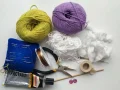
Materials Needed for Quirky Cartoon Snail Amigurumi Pattern

— Main Fabric

  • 01
    Approximately 14g of Sport weight cotton-blend yarn in light green for the body and eyelids
  • 02
    About 7g of Sport weight cotton-blend yarn in purple for the snail shell
  • 03
    Roughly 3g of Sport weight cotton-blend yarn in white for the eyes

— Tools Required

  • 01
    1.75 mm steel crochet hook
  • 02
    Two 14 mm glass eyes
  • 03
    Polyester fiberfill for stuffing
  • 04
    115 cm of 0.75-1 mm thick aluminum or copper craft wire
  • 05
    Strong clear adhesive for securing the glass eyes
  • 06
    Textile band-aid or medical tape for padding wire ends
  • 07
    Small pliers and wire cutters
  • 08
    Wooden skewer or toothpick to help with stuffing small parts
  • 09
    Large sewing needle and scissors

Progress Tracker

0% Complete

— 1. Shell :

Info :

Work this entire section in a continuous spiral using purple yarn.

Round 1 :

6 sc into a MC (6)

Round 2 :

6 inc (12)

Round 3 :

12 sc (12)

Round 4 :

12 sc (12)

Round 5 :

12 sc (12)

Round 6 :

12 sc (12)

Round 7 :

12 sc (12)

Round 8 :

12 sc (12)

Round 9 :

12 sc (12)

Round 10 :

12 sc (12)

Round 11 :

12 sc (12)

Round 12 :

12 sc (12)

Round 13 :

inc, 11 sc (13)

Round 14 :

13 sc (13)

Round 15 :

13 sc (13)

Round 16 :

13 sc (13)

Round 17 :

13 sc (13)

Round 18 :

13 sc (13)

Round 19 :

13 sc (13)

Round 20 :

13 sc (13)

Round 21 :

13 sc (13)

Round 22 :

13 sc (13)

Round 23 :

13 sc (13)

Round 24 :

inc, 12 sc (14)

Round 25 :

14 sc (14)

Round 26 :

14 sc (14)

Round 27 :

14 sc (14)

Round 28 :

14 sc (14)

Round 29 :

14 sc (14)

Round 30 :

3 sc in next st, 13 sc (16)

Round 31 :

sc, 3 sc in next st, 14 sc (18)

Round 32 :

2 sc, 3 sc in next st, 15 sc (20)

Round 33 :

3 sc, 3 sc in next st, 16 sc (22)

Round 34 :

4 sc, 3 sc in next st, 17 sc (24)

Round 35 :

5 ps, 3 ps in next st, 18 ps (26)

Info :

Fasten off and hide the yarn tail. Stuff the shell very lightly with fiberfill.

— 2. Eye (Make Two) :

Info :

Use white yarn and work in a continuous spiral.

Round 1 :

6 sc into a MC (6)

Round 2 :

6 inc (12)

Round 3 :

(sc, inc) * 6 (18)

Round 4 :

(2 sc, inc) * 6 (24)

Round 5 :

24 sc (24)

Round 6 :

24 sc (24)

Round 7 :

24 sc (24)

Round 8 :

(2 sc, dec) * 6 (18)

Round 9 :

(sc, dec) * 6 (12)

Info :

Stuff the eye firmly with fiberfill.

Round 10 :

6 dec (6)

Info :

Fasten off and use the tail to pull the remaining hole closed through the front loops.

— 3. Upper Eyelid (Make Two) :

Info :

Use light green yarn and work in a spiral.

Round 1 :

6 sc into a MC (6)

Round 2 :

6 inc (12)

Round 3 :

(sc, inc) * 6 (18)

Round 4 :

(2 sc, inc) * 6 (24)

Round 5 :

24 sc (24)

Round 6 :

24 sc (24)

Round 7 :

24 sc (24)

Round 8 :

24 sc (24)

Info :

Fasten off and hide the yarn end.

— 4. Lower Eyelid (Make Two) :

Info :

Use light green yarn. Leave a 20 cm tail at the start for sewing.

Round 1 :

5 sc into a MC, but do not pull the ring tight; leave a hole for the wire (5)

Round 2 :

5 sc (5)

Round 3 :

5 sc (5)

Round 4 :

5 sc (5)

Round 5 :

5 sc (5)

Round 6 :

5 sc (5)

Note :

The stitch count for Round 7 is inconsistent in the source. Follow the count of 12 by increasing 7 times across the round.

Round 7 :

7 inc (12)

Round 8 :

(sc, inc) * 6 (18)

Info :

Finish with a sl st. Cut yarn, leaving a tail for assembly. Place the upper eyelid over the lower and join them by working 8 sc through both layers.

— 5. Upper Jaw :

Info :

Use light green yarn.

Round 1 :

6 sc into a MC (6)

Round 2 :

6 sc (6)

Round 3 :

inc, 5 sc (7)

Round 4 :

7 sc (7)

Round 5 :

inc, 6 sc (8)

Round 6 :

8 sc (8)

Round 7 :

3 sl st, sc, 4 hdc (8)

Info :

Fasten off and hide the tail. Prepare a wire loop padded with tape and insert it into the jaw, adding a little stuffing for shape.

— 6. Lower Jaw :

Info :

Use light green yarn.

Round 1 :

4 sc into a MC (4)

Round 2 :

(inc, sc) * 2 (6)

Round 3 :

6 sc, then sl st. Do not stuff (6)

Round 4 :

ch, turn, work 3 sc to join with the upper jaw sl st area. On the upper jaw: sc, 3 hdc, sc. On the lower jaw: 3 sl st (8)

— 7. Body :

Info :

Continue from the joined jaws, working in a spiral around the wire frame.

Round 1 :

8 sc (8)

Round 2 :

8 sc (8)

Round 3 :

dec, 6 sc (7)

Round 4 :

dec, 5 sc (6)

Round 5 :

6 sc (6)

Round 6 :

6 sc (6)

Round 7 :

6 sc (6)

Round 8 :

inc, 5 sc (7)

Round 9 :

7 sc (7)

Round 10 :

inc, 6 sc (8)

Round 11 :

8 sc (8)

Round 12 :

inc, 7 sc (9)

Round 13 :

inc, 8 sc (10)

Round 14 :

(inc, 4 sc) * 2 (12)

Round 15 :

(3 sc, inc) * 3 (15)

Round 16 :

(4 sc, inc) * 3 (18)

Round 17 :

18 sc (18)

Round 18 :

18 sc (18)

Round 19 :

18 sc (18)

Round 20 :

dec, 16 sc (17)

Round 21 :

17 sc (17)

Round 22 :

17 sc (17)

Round 23 :

17 sc (17)

Round 24 :

dec, 15 sc (16)

Round 25 :

16 sc (16)

Round 26 :

16 sc (16)

Round 27 :

16 sc (16)

Round 28 :

dec, 14 sc (15)

Round 29 :

15 sc (15)

Round 30 :

dec, 13 sc (14)

Round 31 :

dec, 12 sc (13)

Round 32 :

dec, 11 sc (12)

Info :

Stuff the body lightly as you go.

Round 33 :

dec, 10 sc (11)

Round 34 :

dec, 9 sc (10)

Round 35 :

dec, 8 sc (9)

Round 36 :

dec, 7 sc (8)

Round 37 :

dec, 6 sc (7)

Round 38 :

7 sc (7)

Round 39 :

7 sc (7)

Round 40 :

7 sc (7)

Round 41 :

7 sc (7)

Round 42 :

7 sc (7)

Round 43 :

7 sc (7)

Round 44 :

7 sc (7)

Round 45 :

7 sc (7)

Round 46 :

7 sc (7)

Round 47 :

7 sc (7)

Round 48 :

7 sc (7)

Round 49 :

7 sc (7)

Round 50 :

7 sc (7)

Round 51 :

7 sc (7)

Info :

Trim any excess wire. Fasten off and pull the hole closed using the front loops.

— 8. Mantle :

Info :

Pick up 47 stitches along the body. Mark 3 center stitches on the chest and count 22 rows down each side.

Row 1 :

rotate, 10 sc, 7 hdc, 5 dc, 3 inc dc, 5 dc, 7 hdc, 10 sc (50)

Row 2 :

sl st on the body, turn, skip 1, 10 inc, 7 inc hdc, 16 inc dc, 7 inc hdc, 10 inc, sl st (100)

Info :

Fasten off and weave in your ends.

Assembly Instructions

  • Bend the snail's body at the thickest point into an 'L' shape to create a base.
  • Coil the shell tightly, starting from the narrow tip, and secure it with a few stitches at the center.
  • Sew the shell to the body using invisible stitches, attaching it between Rounds 34 and 35.
  • Twist the craft wire under each white eye ball and thread the wire ends through the tube of the lower eyelid.
  • Insert the eye wires into the head at the base of the hdc stitches on Round 7 of the upper jaw.
  • Press a small recess into the bottom of the snail's abdomen and sew around the edge to create a flat, stable base for standing.
  • Apply a small amount of glue to the glass eyes and press them into the white eye balls.

Important Notes

  • 💡Keep your tension very tight throughout the project to prevent the stuffing or the wire frame from showing through.
  • 💡If you notice gaps in your fabric, try switching to a slightly smaller hook size.
  • 💡Always stuff the body as you go, as it becomes much harder to fill once the wire is fully enclosed.
  • 💡For children under three, replace the glass eyes with embroidered details or safety eyes for security.
  • 💡Use a wooden skewer to help push fiberfill into the narrower parts of the snail's body and eye stalks.

There is something so rewarding about finishing a project that requires a bit of extra engineering like this one. Once you’ve tucked the last bit of wire away and glued those glass eyes in place, you’ll have a handmade friend that’s full of charm. I hope this pattern brings a bit of whimsy to your crochet hook and a smile to your face every time you look at your finished snail. Happy crocheting, and don't forget to give your new buddy a name! 🧶✨
You ask,

we answer.

FAQs

Can I make this snail without the wire frame?

You can, but the eye stalks will be floppy and won't hold their upright or expressive positions. The wire is what gives this specific snail its cartoonish character.

What kind of wire is best for the armature?

Aluminum craft wire is great because it's very flexible and won't rust. Copper wire also works well if it's a similar thickness (around 1mm).

Is this pattern suitable for a total beginner?

It's best for someone with a few projects under their belt. Working around a wire frame and the specific jaw joining can be a bit tricky for a first-timer.

Can I use a different weight of yarn?

Yes, but it will change the size. If you use a heavier yarn like Worsted, you'll need larger eyes and a thicker wire to support the weight of the eye stalks.