About This Sunburst Crochet Coasters Pattern
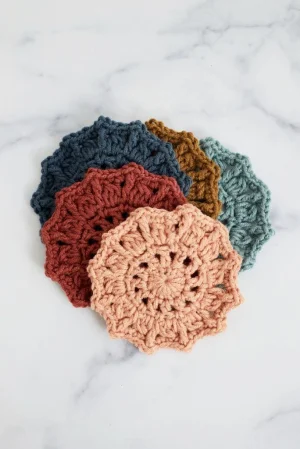
A set of these coasters in five coordinating earthy tones makes one of the most thoughtful handmade housewarming gifts — functional, beautiful, and clearly made with care.
Ideal for those with basic crocheting experience, featuring slightly more advanced stitches and techniques to expand your skills.
Fits nicely into a free afternoon — 2 to 5 hours of focused, enjoyable crocheting.
A warm touch for your space that transforms ordinary corners into inviting nooks filled with handmade charm.
A set of these coasters in five coordinating earthy tones makes one of the most thoughtful handmade housewarming gifts — functional, beautiful, and clearly made with care.
I'll be honest — I wasn't expecting to get as hooked on these as I did. Five rounds sounds like nothing, but that round five with the treble spikes dropping into the sc from two rounds below? It's one of those moments where you pull it through and suddenly the whole thing clicks into shape and you just have to sit there for a second. I love a pattern where the technique teaches you something new without making you feel lost. This one does exactly that.

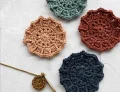
I made my first set of these on a Sunday afternoon when I just needed something small and doable — you know those days when you want to crochet but your brain can't handle anything with a row count over thirty. I pulled out some leftover worsted in a dusty terracotta and just started.
What got me was Round 5. I'd done cluster rounds before, no problem. But that moment where you drop your hook back two full rounds to catch that little sc and pull a treble spike up through — I actually stopped and looked at it for a second. It's one of those construction tricks that feels fancier than it is, but produces results that look genuinely impressive.
I ended up making all five coasters that same afternoon. Set them out on my coffee table, fanned them out a bit, and they looked like something from a home styling shoot. The earthy palette the original pattern suggests — that mix of terracotta, blush, mustard, teal, and slate — is so good together. But I've since made a set in cream and sage for a friend's kitchen and they were equally lovely.
One tip I'd pass on: don't skip the blocking step. I know it sounds fussy for a coaster, but even just a light spritz and a firm press flat while they're damp makes the difference between 'handmade' and 'handcrafted.' The clusters settle, the outer edge lies flat, and the whole thing looks intentional.
These are my go-to last-minute gift now. Wrap a set in a little linen ribbon and they genuinely look like a boutique purchase. Nobody has to know it took you an afternoon.
These little coasters are the kind of project that sneaks up on you — you sit down to make one and suddenly you've got a whole stack in every color. Each one works up in just five rounds, but the finished result looks so much more involved than that. The sunburst design, with its radiating treble crochet spikes and cluster petals, gives your table that handmade-with-intention look. Make a set to keep, make a set to gift — honestly, you'll probably end up doing both.
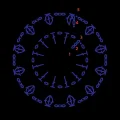
Each coaster is worked in joined rounds from a magic ring. A stitch marker at the start of each round is helpful but not required. When a 3dccl begins a round, the ch 2 counts as the first dc of that cluster. A stitch chart is included in the pattern for visual reference.
3dccl method: Yarn over, insert hook into the stitch. [Yarn over, pull up a loop, yarn over, draw through 2 loops] — you now have 2 loops on the hook. Yarn over, insert hook into that same stitch, repeat the bracketed sequence — 3 loops on hook. Yarn over, insert hook into same stitch once more, repeat again — 4 loops on hook. Yarn over and draw through all 4 loops to close the cluster.
Start with a magic ring. Ch 3 (counts as 1 dc), work 11 dc into the ring, sl st to the top of the ch 3 to join. (12 dc total)
Ch 4 (counts as 1 dc + ch-1 sp), *dc in next st, ch 1, rep from * around, sl st to the 3rd ch of the beginning ch 4 to join. (12 dc + 12 ch-1 sp)
Ch 1, *sc into the next ch-1 sp, ch 2, rep from * around, sl st to the top of the first sc to join. (12 sc + 12 ch-2 sp)
Sl st into the next ch-2 sp, ch 2 (counts as 1st dc of the following 3dccl), complete the 3dccl in that same ch-2 sp, ch 3, *work a 3dccl into the next ch-2 sp, ch 3, rep from * around, sl st to the top of the first 3dccl to join. (12 3dccl + 12 ch-3 sp)
Ch 1, sc in the same st as the join, then work (sc, ch 1, tr into the sc 2 rounds below in Round 3, ch 1, sc) all into the next ch-3 sp. *Sc in the next 3dccl, then work (sc, ch 1, tr into the sc 2 rounds below, ch 1, sc) into the next ch-3 sp. Rep from * around, sl st to the top of the first sc to join. (12 tr + 36 sc + 24 ch-1 sp)
Fasten off. Pull all ends snug and weave them in securely.
There's something quietly satisfying about making something this small that looks this good. 🧶 Five rounds, a handful of stitches, and you've got a coaster that genuinely looks like it belongs in a shop window. Make them in a single colorway for a minimalist vibe, or work through a whole palette of earthy tones for a set that looks gorgeous fanned out on a coffee table. Either way, this is the kind of pattern that earns a permanent spot in your rotation — the one you come back to whenever you need a win. ✨
Cotton works really well for coasters — it's absorbent and holds its shape nicely. Just be aware that cotton has less stretch than acrylic blends, so you may need to go up half a hook size to keep the fabric from pulling too tight, especially in the cluster round.
This almost always happens when the tr is worked into the ch-3 space of Round 4 instead of into the sc from Round 3. The spike effect only happens when you reach back two full rounds — insert your hook directly into that Round 3 sc, even though it means working over Round 4.
Absolutely. The pattern works just as well in a single color — you'd just need one skein, which gives you enough yarn for several coasters at roughly 20 yards each. A monochromatic set in a neutral linen or cream looks really elegant.
A bit of curl before finishing is normal, especially with acrylic yarn. Block the finished coaster by dampening it lightly and pinning it flat to a foam board or towel while it dries. This usually resolves the curl completely.
The finished coaster should measure 4 inches in diameter. If yours is coming out noticeably smaller, try loosening your tension or going up to a 5.5mm hook. If it's larger and floppy, drop down to a 4.5mm hook instead.